Forward Deployed Engineer: What They Do, Skills, Salary and Career Path

Forward Deployed Engineer: What They Do, Skills, Salary and Career Path
Software companies have traditionally separated engineering, sales, consulting, and customer support into different teams. But as software becomes more complex—especially in AI, cloud infrastructure, cybersecurity, and enterprise SaaS—companies increasingly need engineers who can work directly with customers and solve problems in real-world environments.
This is where the forward deployed engineer comes in.
A forward deployed engineer combines software engineering skills with customer-facing problem solving. Instead of spending all their time building a general-purpose product, they work closely with customers to understand their technical challenges, build solutions, integrate systems, and feed real-world requirements back to the core engineering team.
The role has become particularly interesting for startups and AI companies because customers often need highly customized solutions before a product can deliver value.
For a startup CEO, hiring the right forward deployed engineer can mean the difference between a customer simply buying software and actually getting measurable results from it.
What Is a Forward Deployed Engineer and What Roles Do They Have?
So, what is forward deployed engineer in practical terms?
A forward deployed engineer is a technical professional who works close to customers to implement, customize, troubleshoot, and improve software solutions.
Think of them as the connection between:
- The customer
- Sales and business teams
- Product managers
- Software engineers
- Data engineers
- DevOps and infrastructure teams
A traditional software engineer might receive a product requirement and build a feature according to a specification. A forward deployed engineer is often closer to the original problem. They may talk directly with the customer, investigate the customer's infrastructure, write code, connect APIs, deploy the solution, and verify that the result actually solves the business problem.
Typical forward deployed engineer roles
The exact responsibilities vary from company to company, but common forward deployed engineer roles include:
Customer implementation
Helping customers integrate a company's product into their existing technology stack.
Custom development
Writing code, scripts, APIs, integrations, or internal tools that are required for a particular customer.
Technical problem solving
Investigating why a product does not work properly in a customer's environment and developing a practical solution.
Product feedback
Identifying repeated customer problems and communicating them to product and engineering teams.
Technical discovery
Working with customers to understand their infrastructure, workflows, data, and business requirements.
Deployment
Helping move solutions from development into production environments.
The role is especially valuable when a company sells complex products. For example, an AI platform may technically work, but every enterprise customer could have different data sources, security requirements, authentication systems, and workflows.
A forward deployed engineer helps bridge that gap.
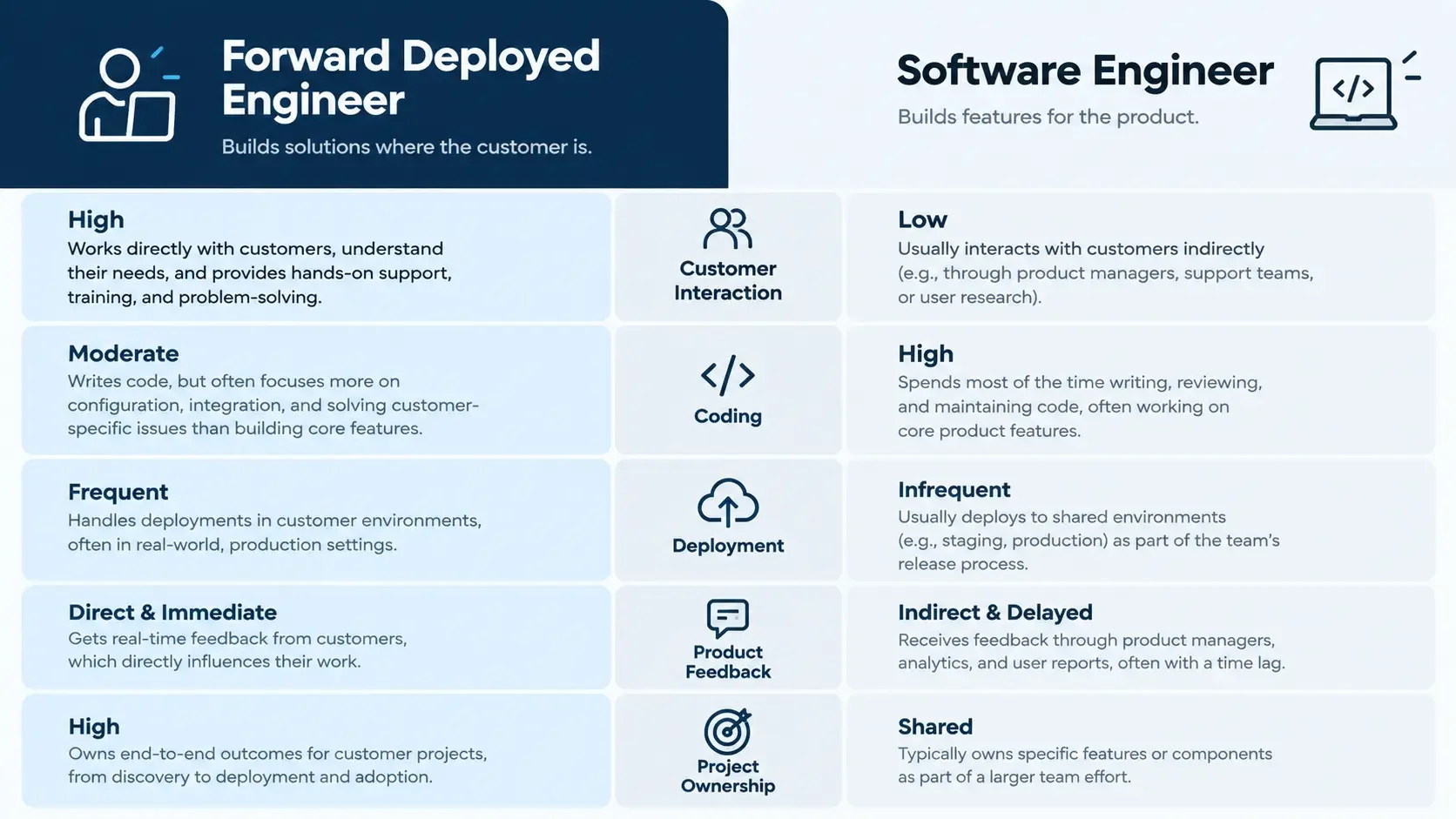
Forward deployed engineer vs software engineer
The biggest difference is where the engineer's attention is focused.
A software engineer generally focuses on building and maintaining the company's core technology. A forward deployed engineer spends much more time applying that technology to individual customer problems.
That does not mean forward deployed engineers are "less technical." In many companies, they need excellent engineering skills because they are working with APIs, databases, cloud platforms, distributed systems, authentication, data pipelines, and production deployments.
The difference is primarily context and proximity to the customer.
Forward deployed engineer vs solutions engineer
There is also significant overlap between a forward deployed engineer and a solutions engineer.
A solutions engineer is usually more involved in technical sales, demonstrations, architecture discussions, proof-of-concepts, and helping prospects understand how a product fits their requirements.
A forward deployed engineer is typically more involved after—or toward the end of—the sales process, when the actual implementation and technical problem solving begin.
However, companies define these positions differently. In a startup, one person might effectively perform both jobs.
Forward Deployed Engineer Jobs, Salary, Certification and How to Become One
The growing complexity of software has created demand for engineers who can operate across technical and business environments.
This makes forward deployed engineer jobs particularly attractive to developers who enjoy more than writing code in isolation.
What skills do you need?
A strong forward deployed engineer usually has a broad technical skill set rather than being narrowly specialized.
Important skills include:
- JavaScript or TypeScript
- Python
- React and modern frontend development
- Node.js
- REST and GraphQL APIs
- SQL and databases
- Cloud platforms
- Docker
- Git
- CI/CD
- Authentication and authorization
- Data integration
- Debugging
- System design
- Basic DevOps
- Communication and customer discovery
You do not necessarily need to master every technology.
The more important ability is learning unfamiliar systems quickly.
For example, a customer might use PostgreSQL, AWS, React, a legacy ERP, several REST APIs, and an internal authentication system. The engineer needs to understand enough of each technology to connect the pieces and deliver a working solution.
Forward deployed engineer salary
The forward deployed engineer salary varies considerably depending on location, company, experience, industry, and technical specialization.
AI startups and enterprise technology companies can offer particularly competitive compensation because the role combines engineering expertise with customer-facing responsibilities.
Instead of focusing only on an average salary number, candidates should consider the entire compensation package:
- Base salary
- Bonus
- Equity
- Benefits
- Travel requirements
- Remote flexibility
- Career progression
- Technical ownership
- Customer exposure
The role can also provide unusually strong career development because engineers see how technology is used in real businesses.
Forward deployed engineer Google and other major technology companies
Large technology companies have helped make the concept more visible, but the role is not limited to one organization.
Searches for forward deployed engineer Google and similar positions demonstrate the broader trend: technology companies increasingly need engineers who can take sophisticated products and make them useful in specific customer environments.
AI companies are particularly suited to this model.
An AI product may require customer-specific data connections, retrieval pipelines, model evaluation, security controls, workflow automation, or custom interfaces.
A forward deployed engineer can build these components while working directly with the customer.
Do you need a forward deployed engineer certification?
There is no universal forward deployed engineer certification that qualifies someone for the job.
In most cases, companies care more about demonstrated engineering ability than a specific certificate.
Certifications can still be useful for areas such as:
- AWS
- Microsoft Azure
- Google Cloud
- Kubernetes
- Security
- Data engineering
But a portfolio showing that you can build and deploy real applications can be more valuable.
For example, building a small SaaS application with a React frontend, Node.js backend, PostgreSQL database, authentication, Docker deployment, and third-party API integrations demonstrates many of the skills required for the position.
Forward deployed engineer intern opportunities
A forward deployed engineer intern position can be a great entry point for students and junior developers.
Interns can gain experience in:
- Customer discovery
- Software implementation
- Debugging
- API integrations
- Data analysis
- Cloud infrastructure
- Technical documentation
- Product feedback
Because the role sits between engineering and customers, it can also develop communication skills that are difficult to learn from coding projects alone.
How to become a forward deployed engineer
If you are wondering how to become forward deployed engineer, start by becoming a strong generalist developer.
You should be able to build an application from beginning to end.
For example:
- Build a frontend using React.
- Create a backend using Node.js, NestJS, or another framework.
- Connect a database.
- Build and consume APIs.
- Add authentication.
- Containerize the application with Docker.
- Deploy it to the cloud.
- Monitor errors and performance.
- Integrate a third-party service.
- Explain the technical decisions to a non-technical person.
The last step is extremely important.
A forward deployed engineer must be able to translate:
"Our order data is spread across three systems."
into:
"We can build an integration that synchronizes those systems and gives your team one operational view."
That ability to translate business problems into technical solutions is one of the defining characteristics of the role.
Why Startups Are Hiring Forward Deployed Engineers
For startups, the role can solve a common problem: customers want a product to work with their existing business processes, while the startup wants to build a scalable product rather than create completely custom software for every customer.
A forward deployed engineer can help find the middle ground.
Suppose a SaaS company has 20 customers.
Customer A needs Salesforce integration.
Customer B uses HubSpot.
Customer C has an old internal database.
Customer D needs a custom reporting dashboard.
If developers in the core product team handle every customer request, product development can quickly become chaotic.
A forward deployed engineer can investigate these requirements and determine which solutions should be:
- Custom configuration
- Customer-specific integration
- Reusable product functionality
- A new core product feature
- Rejected because the requirement is too specific
This creates an important feedback loop.
Customer → Forward Deployed Engineer → Product Team → Better Product → More Customers
That feedback loop can be extremely valuable for an early-stage company.
Forward deployed engineer AI opportunities
AI has made this role even more interesting.
A company selling an AI product might have a technically impressive model but still struggle to deploy it successfully for enterprise customers.
The customer might ask:
"Can you connect this to our internal documents?"
"Can it work with our existing authentication?"
"Can employees access it through our internal application?"
"Can we automatically evaluate the answers?"
"Can the system retrieve information from our database?"
These are engineering problems, not simply sales questions.
A forward deployed engineer AI role can therefore involve:
- LLM integrations
- Retrieval-augmented generation
- Vector databases
- AI agents
- API integrations
- Data pipelines
- Model evaluation
- Prompt engineering
- Security
- Cloud deployment
- Monitoring
This is one reason the role is becoming increasingly attractive in AI startups.
How the Role Fits Into a Modern Full-Stack Team
Forward deployed engineering does not replace traditional software engineering.
Instead, the two functions work together.
A typical architecture might look like this:
Customer environment
↓
Forward deployed engineer
↓
APIs / integrations / custom application
↓
Core SaaS platform
↓
Product and engineering team
The forward deployed engineer might build a customer-specific integration and then identify that several other customers need the same functionality.
The core engineering team can then turn that custom implementation into a reusable product feature.
This is particularly important when designing SaaS architecture.
For example, developers may need to decide between different backend approaches. Questions such as NestJS vs Express can become relevant when determining how much structure a backend needs.
Similarly, a team might compare Fastify vs Express when performance and framework overhead become important.
For event-driven systems, understanding Kafka vs Redis can help teams decide whether they need durable event streaming or simpler real-time messaging.
These decisions matter because a forward deployed engineer is often working at the intersection of the customer's existing infrastructure and the startup's architecture.
Hiring the right engineer
For startup CEOs, hiring should not focus only on years of experience.
Look for someone who can:
- Understand an unfamiliar system quickly
- Write production-quality code
- Communicate with customers
- Ask good technical questions
- Debug under pressure
- Understand APIs and databases
- Work independently
- Make reasonable architecture decisions
- Document their work
- Know when a custom solution should become a product feature
A developer who can code extremely well but cannot communicate with customers may struggle in the position.
Likewise, someone who communicates well but cannot independently troubleshoot production systems may require too much support.
The ideal candidate combines both abilities.
This is also why companies sometimes consider hiring a remote full stack developer for parts of the role. A remote developer with strong full-stack skills can handle integrations and implementation work, although customer-facing responsibilities may require overlapping working hours and strong communication.
Is a Forward Deployed Engineer Right for Your Company?
Not every company needs one.
The role makes the most sense when customers have technically complex implementations.
You may benefit from a forward deployed engineer if:
- Your customers need custom integrations.
- Every enterprise deployment is slightly different.
- Your sales team frequently promises technical solutions.
- Your engineering team spends too much time on customer-specific work.
- Customers need help connecting your software to existing systems.
- Your product involves AI or complex data workflows.
- You sell enterprise SaaS.
- Customer feedback needs to reach engineering quickly.
For a simple consumer application where every customer uses the product in exactly the same way, the role may provide little value.
For an enterprise AI startup, however, it can become a critical part of the organization.
The most important point is that forward deployed engineering is not simply "software engineering with more meetings."
It represents a different way of building software.
Instead of asking only:
"What feature should we build?"
the engineer also asks:
"What problem is the customer actually trying to solve, and what is the simplest reliable technical solution?"
That mindset can help startups avoid overengineering while discovering which customer requirements deserve to become permanent parts of the product.
For developers, it can provide a career that combines coding, architecture, product thinking, and direct customer impact.
For startups, it can create a valuable bridge between the product being built and the problems customers are actually willing to pay to solve.
Frequently Asked Questions
Everything you need to know about our development services.
A forward deployed engineer works directly with customers to implement software, build integrations, solve technical problems, deploy applications, and communicate customer requirements back to the product and engineering teams.
Yes, but the responsibilities are different. A forward deployed engineer usually spends more time working directly with customers and solving implementation-specific problems, while a software engineer generally focuses more heavily on building and maintaining the core product
Not necessarily. Strong practical engineering skills, system understanding, problem solving, and communication can be more important than a specific degree. A strong portfolio of deployed projects can also demonstrate your abilities.
Yes. AI products often require customer-specific integrations, data pipelines, authentication, evaluation systems, and deployment work. This creates strong opportunities for engineers who understand both software development and customer problems.
If your customers frequently require custom integrations or technical implementation, the role can be very valuable. It can reduce the amount of customer-specific work handled by the core engineering team while creating a direct feedback loop between customers and product development.