NestJS vs Express: Choosing a Backend Architecture for a SaaS
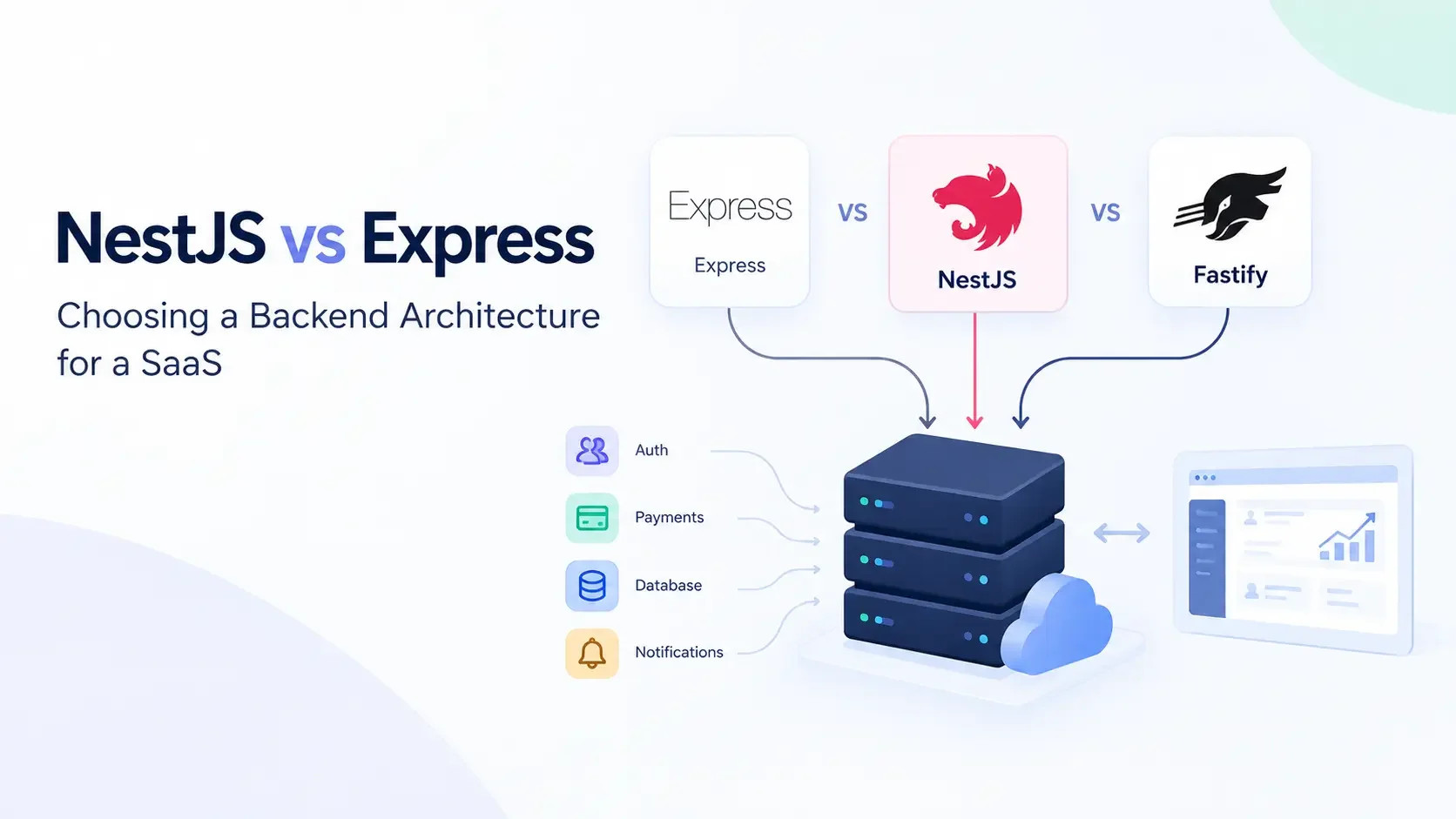
Choosing the right backend architecture is one of the most important technical decisions when building a SaaS product. The backend needs to do much more than simply expose APIs. As the product grows, it may need to handle authentication, user management, organizations, roles and permissions, subscriptions, payments, webhooks, background jobs, notifications, third-party integrations, and large amounts of business logic.
Two of the most popular Node.js options for building these systems are Express and NestJS. Fastify is another strong option, particularly for applications where performance is a major consideration.
The right choice depends on the size of your application, your development team, expected growth, and how much structure you want the framework to provide.
Quick Comparison
| Feature | Express | NestJS | Fastify |
| Learning curve | Easy | Moderate | Easy–Moderate |
| Architecture | Minimal | Structured | Lightweight |
| TypeScript | Excellent | Excellent | Excellent |
| Dependency Injection | ❌ | ✅ Built-in | ❌ |
| Scalability | Good | Excellent | Excellent |
| Performance | Good | Good | Excellent |
| Large teams | Good with conventions | Excellent | Good |
| Flexibility | Excellent | Good | Excellent |
| Best for | MVPs & APIs | Growing SaaS | High-performance APIs |
The table shows an important difference: Express and Fastify are relatively lightweight frameworks, while NestJS provides a more complete architecture for organizing an application.
This doesn't mean NestJS is automatically better. For a simple API with five endpoints, its additional structure may not provide much value. But for a SaaS with dozens of modules and multiple developers, that structure can become a major advantage.
Express: Simple and Flexible
Express has been one of the most popular Node.js backend frameworks for years. Its biggest strength is that it stays out of your way.
You get routing, middleware, request handling, and a large ecosystem of packages, while you remain free to decide how your application should be designed.
A small Express application might look like:
src/
├── routes/
├── controllers/
├── services/
├── models/
└── middleware/
This is excellent for an MVP because you can move quickly. If you need a new endpoint, you can create a route, connect it to a controller, call your service, and return the response.
Express also has a huge ecosystem. There are mature solutions and integrations for authentication, databases, logging, validation, file uploads, security, testing, and many other requirements.
The challenge appears when the application becomes large.
Imagine your SaaS eventually contains:
- Authentication
- Users
- Organizations
- Projects
- Teams
- Billing
- Subscriptions
- Notifications
- Reports
- Analytics
- Admin
- Files
- Integrations
Express doesn't tell you how these areas should be organized. Your team has to create those rules.
That flexibility can lead to different developers solving the same problem in different ways. Business logic may end up inside controllers, middleware may become difficult to manage, and common functionality can become scattered across the project.
This isn't necessarily a problem with Express itself. Experienced teams can build extremely well-structured Express applications. The difference is that the team has to create and enforce that architecture themselves.
Express is a great choice when: you're building an MVP, have a small team, want maximum flexibility, need a lightweight backend, or already have an Express-based application.
For a small SaaS with a straightforward domain, Express can remain a perfectly good choice even in production.
NestJS: Built for Structured Applications
NestJS takes a more opinionated approach to backend development. Instead of leaving most architectural decisions to the developer, it provides a consistent structure based around modules, controllers, services, dependency injection, guards, pipes, interceptors, and other building blocks.
A SaaS backend could be organized like this:
src/
├── auth/
├── users/
├── organizations/
├── billing/
├── projects/
├── notifications/
└── admin/
Each area can have its own controllers, services, validation, and supporting components.
This becomes particularly useful when the application grows.
For example, the billing module might contain:
billing/
├── billing.controller.ts
├── billing.service.ts
├── subscription.service.ts
├── payment.service.ts
└── billing.module.ts
This creates clear boundaries between different parts of the application.
Dependency injection
One of NestJS's biggest advantages is its built-in dependency injection system.
Instead of manually creating services and passing their dependencies around, NestJS manages these relationships for you.
For a SaaS, this becomes useful when a service depends on several other components:
SubscriptionService
↓
PaymentService
↓
StripeService
↓
EmailService
As the application grows, dependency injection makes these relationships easier to manage and test.
Authentication and authorization
SaaS applications often have complicated permission systems.
For example:
- Owner
- Admin
- Manager
- Member
- Viewer
You may also have organization-level permissions such as:
- projects.read
- projects.write
- users.invite
- billing.manage
- reports.view
NestJS guards provide a structured way to implement authentication and authorization before a request reaches the business logic.
Better consistency for teams
Another major advantage is consistency.
When five or ten developers work on a NestJS project, they have a common framework for organizing features. A developer joining the project can usually understand where controllers, services, modules, and other components belong.
That can significantly reduce the long-term maintenance cost of a SaaS.
NestJS also supports both Express and Fastify underneath, so you can use NestJS's application architecture without being tied exclusively to one HTTP platform.
Fastify: Performance-Focused Alternative
Fastify is another strong option for Node.js applications. Its primary focus is efficient HTTP handling, low overhead, and high performance.
It also provides schema-based validation and serialization, which can be useful for API-heavy applications.
A Fastify application can remain relatively lightweight while still providing useful features such as:
- Request validation
- Response serialization
- Plugins
- Hooks
- Logging
- TypeScript support
- High-performance HTTP handling
Fastify can therefore be a good choice for APIs that process large numbers of requests or have strict latency requirements.
However, Fastify is not designed to dictate your entire application architecture.
You still need to decide how to organize:
- Controllers
- Services
- Business logic
- Authentication
- Authorization
- Database access
- Background jobs
- Integrations
This makes Fastify somewhat similar to Express from an architectural perspective: it gives you a strong foundation, but your team is responsible for designing the application structure. Learn about Fastify vs Express: Which Is Better for a Production Node.js API?
One particularly interesting option for SaaS development is:
NestJS
↓
Fastify Adapter
↓
Node.js
This combines NestJS's structured architecture with Fastify as the underlying HTTP platform.
For many SaaS applications, this is a good balance between developer productivity, maintainability, and performance.
Which Architecture Is Best for a SaaS?
For most new SaaS products, I would recommend starting with a modular monolith rather than immediately jumping into microservices.
A practical architecture could look like:
Frontend
↓
NestJS + Fastify
↓
Domain Modules
↓
PostgreSQL
↓
Redis + Background Jobs
Your backend might contain modules such as:
- AuthModule
- UsersModule
- OrganizationsModule
- BillingModule
- ProjectsModule
- NotificationsModule
- AdminModule
Everything can initially run as one application, but the internal boundaries remain clear.
This is important because SaaS products often change significantly during their early stages. Building ten separate microservices before you know how your product will evolve can introduce unnecessary complexity.
A modular monolith gives you the simplicity of one application while still encouraging good architectural boundaries.
Our recommendation
For a small MVP: Express is an excellent choice.
For a high-performance API: Fastify is worth considering.
For a serious SaaS expected to grow: NestJS is our preferred choice, particularly with TypeScript and a modular monolith architecture.
A strong starting stack could be:
NestJS/Fastify + TypeScript + PostgreSQL + Redis + background workers
This gives you a structured backend without forcing you to deal with the operational complexity of microservices from day one.
The main advantage of NestJS isn't that it magically makes your application faster. Its biggest advantage is maintainability.
As your SaaS grows from 10 users to 10,000 or more, the ability to keep authentication, billing, organizations, projects, and other business domains clearly separated becomes increasingly valuable.
Express gives you freedom. NestJS gives you structure. For a long-term SaaS, that structure can make a significant difference.
Frequently Asked Questions
Not for every project. Express is simpler and more flexible, making it excellent for smaller applications and MVPs. NestJS is generally more suitable when your SaaS has complex business logic, many modules, or a larger development team.
Not necessarily. Raw framework performance is only one part of real-world SaaS performance. Database queries, caching, network requests, external APIs, and application logic often have a much greater impact.
Yes. NestJS supports both Express and Fastify as underlying HTTP platforms. This means you can use NestJS's architecture while using Fastify for HTTP handling.
Usually, no. Unless you have a specific technical or organizational reason, starting with a modular monolith is generally simpler. You can extract individual modules into microservices later as the product grows.
Fastify is designed for high performance and efficient HTTP processing, while Express offers a very mature ecosystem and simple programming model. The better choice depends on your application's requirements. Learn more about Fastify vs Express.
There is no universal answer, but a strong modern choice is: NestJS + Fastify + TypeScript + PostgreSQL + Redis + background workers. This combination provides a structured application architecture while remaining flexible enough to evolve as your SaaS grows.