Fastify vs Express: Which Is Better for a Production Node.js API?
Choosing a Node.js web framework is easy when you're building a small REST API.
Choosing one for a production system that needs to scale, remain maintainable, handle high traffic, validate thousands of requests, integrate with databases and queues, expose observability, and be maintained by a team for years is a different problem.
Two names consistently appear in that conversation:
- Express — the mature, minimalist, extremely popular Node.js web framework.
- Fastify — a newer, performance-oriented framework designed around low overhead, structured plugins, schema validation, and serialization.
So, which one should you use for a production Node.js API?
For a new API where performance, structured architecture, validation, TypeScript, and long-term scalability are important, I would generally choose Fastify.
However, that doesn't make Express obsolete. Express remains an excellent choice when ecosystem compatibility, team familiarity, existing middleware, or migration cost matters more than maximum framework-level performance.
The important question isn't simply:
"Which framework is faster?"
It's: "Which framework gives my production API the best combination of performance, maintainability, ecosystem, safety, developer productivity, and operational reliability?"
Let's examine that question properly.
Fastify vs Express at a Glance
| Area | Fastify | Express |
| Performance | ⭐⭐⭐⭐⭐ | ⭐⭐⭐⭐ |
| Request validation | Excellent, schema-first | Usually third-party |
| Response serialization | Excellent, schema-aware | Usually manual/standard JSON |
| Middleware ecosystem | Good | Excellent |
| Plugin architecture | Excellent | Good |
| TypeScript experience | Strong | Good |
| Learning curve | Moderate | Very easy |
| Existing ecosystem | Growing | Huge and mature |
| Architectural opinion | More structured | Minimalist |
| High-throughput APIs | Excellent | Good |
| Legacy compatibility | Lower | Excellent |
| Microservices | Excellent | Excellent |
| Large existing Express codebase | Migration required | Natural choice |
| New production API | Strong choice | Strong choice |
| Framework overhead | Low | Low, but higher than Fastify |
| Schema-driven API design | Excellent | Requires additional tooling |
The winner depends on your requirements, but Fastify has the stronger technical profile for many new API-first production applications.
What Is Express?
Express is a minimalist web framework for Node.js.
Its philosophy is deliberately simple: provide routing and middleware primitives and let developers decide how to structure the rest of the application.
An Express application is essentially a chain of middleware functions that process requests and responses.
A minimal API looks like this:
const express = require('express');

const app = express();
app.use(express.json());

app.get('/users', async (req, res) => {
  const users = await getUsers();
  res.json(users);
});

app.listen(3000);
This simplicity is one of Express's biggest strengths. You aren't forced into a particular architecture.
You can build:
- a tiny REST API,
- a monolith,
- a microservice,
- a server-rendered application,
- an API gateway,
- a BFF,
- or a large enterprise application.
The downside is equally important: Express gives you a lot of architectural freedom.
That means your team is responsible for deciding:
- validation strategy,
- serialization strategy,
- project structure,
- dependency boundaries,
- authentication architecture,
- logging,
- observability,
- error handling,
- API contracts,
- and many other concerns.
Freedom is powerful, but at scale it can become inconsistent.
What Is Fastify?
Fastify is a Node.js web framework designed around low overhead and high performance, while providing a more structured approach to building APIs.
A basic Fastify server looks like this:
import Fastify from 'fastify';
const app = Fastify({
  logger: true
});
app.get('/users', async () => {
  return getUsers();
});
await app.listen({
  port: 3000
});
The API looks similar to Express, but Fastify introduces several important concepts:
- plugins,
- encapsulation,
- lifecycle hooks,
- JSON Schema,
- validation,
- response serialization,
- structured logging,
- decorators,
- and a more explicit request lifecycle.
Fastify's official documentation describes it as a low-overhead Node.js web framework and emphasizes performance as one of its core design goals. This makes Fastify particularly interesting for API-heavy systems.
Performance: Fastify Has the Advantage
Performance is probably the most frequently discussed difference. Fastify's current official benchmark page reports, for its illustrative single-instance benchmark:
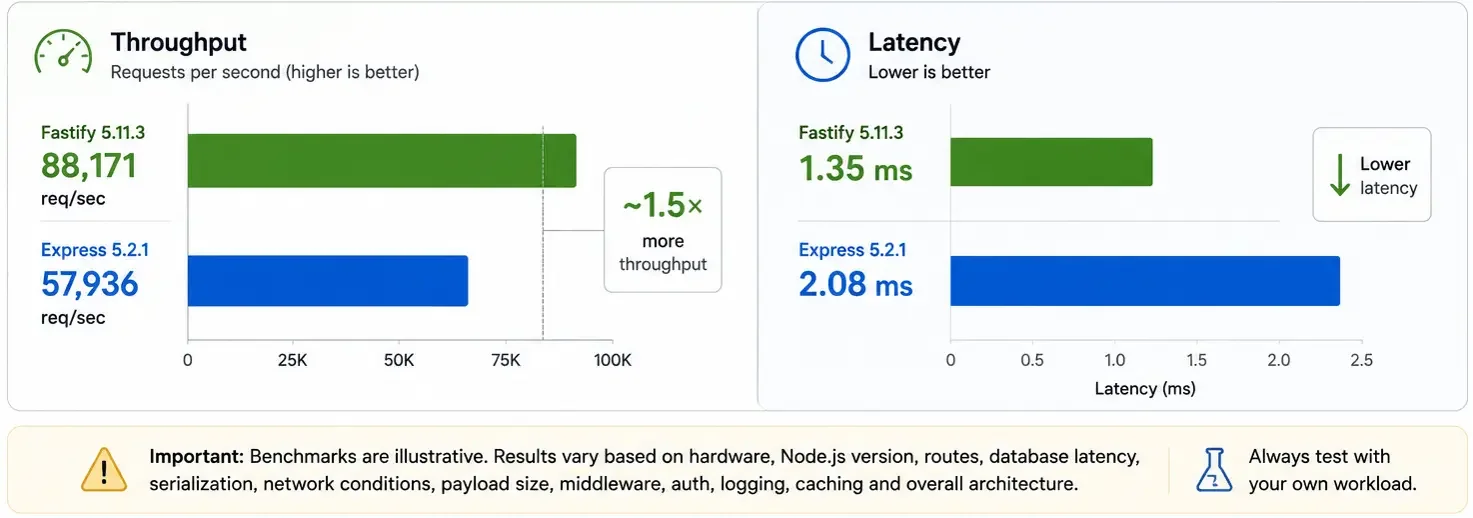
- Fastify 5.11.3: 88,171 requests/second
- Express 5.2.1: 57,936 requests/second
That benchmark puts Fastify at approximately 1.5× the throughput of Express under that particular workload. Fastify also reports lower latency in the same benchmark. But don't make the mistake of interpreting this as: "Fastify makes every application 1.5× faster." It doesn't.
Benchmarks depend on:
- hardware,
- Node.js version,
- route complexity,
- database latency,
- serialization,
- network conditions,
- payload size,
- middleware,
- authentication,
- logging,
- caching,
- and application architecture.
Fastify itself explicitly describes its benchmark figures as illustrative and recommends testing against your own workload.
Why can Fastify be faster?
One major reason is that Fastify is designed with low framework overhead in mind.
It also uses optimized schema-based serialization when response schemas are provided.
For example:
const userResponse = {
  type: 'object',
  properties: {
    id: { type: 'integer' },
    name: { type: 'string' },
    email: { type: 'string' }
  }
};
fastify.get('/users/:id', {
  schema: {
    response: {
      200: userResponse
    }
  }
}, async (request) => {
  return getUser(request.params.id);
});
Fastify can compile schemas for validation and serialization rather than treating every request as an entirely dynamic operation.
The Database Usually Matters More Than the Framework
This is an important production engineering lesson.
Imagine an endpoint that takes: 2 ms inside Fastify versus: 3 ms inside Express.
But the endpoint performs:
- Database query: 80 ms
- Redis: 5 ms
- External API: 100 ms
The framework difference is almost irrelevant. Your actual latency is dominated by I/O.
Therefore: Don't choose Fastify solely because a benchmark says it has more requests/second. Choose it because its architecture also gives you useful production capabilities.
Performance is most valuable when:
- CPU overhead matters,
- request volume is high,
- responses are small,
- APIs are latency-sensitive,
- you have many concurrent connections,
- or infrastructure efficiency matters.
Request Validation: A Major Fastify Advantage
This is one of the most important differences. A production API shouldn't simply accept arbitrary input.
Consider:
POST /users
with:
{
"name": "Alice",
"email": "alice@example.com",
"age": 25
}
You need to determine:
- Is name present?
- Is it a string?
- Is email valid?
- Is age an integer?
- Is age within an acceptable range?
- Are additional fields allowed?
In Express, validation is commonly implemented using additional libraries and middleware.
In Fastify, validation is integrated into the framework's route model.
Fastify recommends JSON Schema for validating requests and serializing responses. Its validation system uses Ajv, while response serialization can use fast-json-stringify.
For example:
const createUserSchema = {
  body: {
    type: 'object',
    required: ['name', 'email'],
    properties: {
      name: {
        type: 'string',
        minLength: 2
      },
      email: {
        type: 'string',
        format: 'email'
      },
      age: {
        type: 'integer',
        minimum: 18
      }
    },
    additionalProperties: false
  }
};
fastify.post('/users', {
  schema: createUserSchema
}, async (request, reply) => {
  const user = await createUser(request.body);
  return reply.code(201).send(user);
});
This provides a much clearer contract. Invalid requests can be rejected before reaching your business logic making it an important production property.
Response Schemas Are More Important Than Many Developers Realize
Developers often think validation only means: "Validate the incoming request."
Production APIs should also think about: "What exactly are we sending back?"
Suppose your database returns:
{
  id: 1,
  name: 'Alam',
  email: 'alam@example.com',
  passwordHash: 'secret',
  internalNotes: 'VIP customer'
}
You don't want to accidentally serialize everything.
A response schema can explicitly define what the API is allowed to expose:
const userResponseSchema = {
  type: 'object',
  properties: {
    id: { type: 'integer' },
    name: { type: 'string' },
    email: { type: 'string' }
  }
};
Fastify's documentation notes that response schemas can improve serialization performance and help prevent accidental disclosure of sensitive fields. That makes schemas useful for more than performance and they become part of your API contract.
Express: Middleware Is Its Superpower
Express's biggest advantage is its ecosystem. The middleware model is extremely simple:
app.use((req, res, next) => {
  console.log(req.method, req.url);
  next();
});
Middleware can:
- modify requests,
- modify responses,
- authenticate users,
- log requests,
- parse bodies,
- handle sessions,
- apply rate limiting,
- add headers,
- and perform many other tasks.
Express documentation describes middleware as functions participating in the request-response cycle and passing control through next().
This model has been around for years. As a result, there is an enormous ecosystem of Express-compatible packages and examples. If you search for: "How do I implement X in Express?", there is a very high probability that someone has already solved it and that is a significant production advantage.
Fastify's Plugin Architecture
Fastify takes a somewhat different approach. Instead of making everything a global middleware chain, Fastify heavily emphasizes plugins and encapsulation.
Conceptually:
fastify.register(authPlugin);
fastify.register(userRoutes, {
  prefix: '/users'
});
fastify.register(orderRoutes, {
  prefix: '/orders'
});
This encourages modular application design.
For example:
src/
├── app.js
├── server.js
│
├── plugins/
│ ├── database.js
│ ├── authentication.js
│ └── logger.js
│
├── modules/
│ ├── users/
│ │ ├── routes.js
│ │ ├── service.js
│ │ ├── schema.js
│ │ └── repository.js
│ │
│ └── orders/
│ ├── routes.js
│ ├── service.js
│ ├── schema.js
│ └── repository.js
│
└── config/
└── index.js
This structure works particularly well as a codebase grows. Fastify's plugin system and encapsulation are designed to create boundaries between parts of the application. Its ecosystem includes official and community plugins covering common server concerns.
TypeScript: Fastify Is Particularly Attractive
Both frameworks can be used successfully with TypeScript. However, Fastify's architecture works particularly well with schema-driven APIs.
For example, Fastify's current documentation demonstrates TypeBox integration for deriving types from schemas:
import Fastify from 'fastify';
import { Type } from '@sinclair/typebox';
import type {
  TypeBoxTypeProvider
} from '@fastify/type-provider-typebox';
const app = Fastify()
  .withTypeProvider<TypeBoxTypeProvider>();
app.get('/users/:id', {
  schema: {
    params: Type.Object({
      id: Type.String()
    }),
    response: {
      200: Type.Object({
        id: Type.Number(),
        name: Type.String()
      })
    }
  }
}, async (request) => {
  return {
    id: 1,
    name: 'Alice'
  };
});
Now your API schema can participate in both:
- runtime validation,
- and compile-time type checking.
Express + TypeScript Is Still Excellent
Don't interpret the previous section as: "Express isn't good with TypeScript." It absolutely is. A typical Express route might look like:
import express, {
  Request,
  Response
} from 'express';
const app = express();
app.get(
  '/users/:id',
  async (
    req: Request<{ id: string }>,
    res: Response
  ) => {
    const user = await getUser(req.params.id);
    res.json(user);
  }
);
The difference is that you generally assemble more of the type/validation architecture yourself.
You might combine Express with:
- Zod,
- TypeScript,
- OpenAPI,
- custom middleware,
- database types,
- generated clients.
That can work extremely well. In fact, if your organization already has a standardized Express + TypeScript stack, switching frameworks simply for theoretical performance may be a poor engineering decision.
Error Handling
Error handling is another important architectural difference. Express provides built-in error handling, and custom error-handling middleware follows the familiar: (err, req, res, next) pattern.
Express 5 also automatically forwards rejected promises from route handlers and middleware to its error handling mechanism. A production Express application might use:
app.use((err, req, res, next) => {
  console.error(err);
  res.status(500).json({
    error: 'Internal server error'
  });
});
Fastify Error Handling
Fastify provides its own error handling model integrated into its request lifecycle.
A route can use:
fastify.get('/users/:id', async (request, reply) => {
  const user = await findUser(request.params.id);
  if (!user) {
    return reply.code(404).send({
      error: 'User not found'
    });
  }
  return user;
});
You can also define centralized error behavior. The important production principle is the same regardless of framework: Errors should be predictable, structured, observable, and safe for clients.
A good API should distinguish between:
- 400 Bad Request
- 401 Unauthorized
- 403 Forbidden
- 404 Not Found
- 409 Conflict
- 422 Unprocessable Entity
- 429 Too Many Requests
- 500 Internal Server Error
- 503 Service Unavailable
Don't return HTTP 500 for every problem.
Logging and Observability
Production APIs need more than: console.log('request received');
You need:
- structured logs,
- request IDs,
- latency measurements,
- error rates,
- metrics,
- traces,
- health checks,
- and useful context.
Fastify has structured logging support built into its ecosystem and commonly uses Pino.
For example:
const fastify = Fastify({
  logger: true
});
This is convenient for production deployments. Express also supports excellent logging architectures, but you typically assemble them from middleware and logging libraries.
The framework matters less here than whether your team implements proper observability.
Production Security
Neither Fastify nor Express automatically makes an API secure. You still need to think about:
Authentication
Examples:
- JWT
- OAuth 2.0
- OpenID Connect
- session-based authentication
Authorization
Authentication asks:
Who are you?
Authorization asks:
Are you allowed to perform this operation?
Rate limiting
Protect expensive endpoints:
POST /login
POST /password-reset
POST /checkout
Input validation
Never trust:
- query parameters,
- request bodies,
- headers,
- cookies,
- URL parameters.
HTTP security headers
Use appropriate security headers and TLS.
Secrets
Never commit:
DATABASE_PASSWORD
JWT_SECRET
API_KEY
to Git.
Use environment variables or a secret-management system.
Dependency security
Regularly scan dependencies and keep production dependencies maintained. Security is an application architecture problem, not a framework checkbox.
Production Performance Is More Than Requests per Second
When evaluating Fastify vs Express, measure the metrics that actually affect your business.
Important metrics include:
Throughput
requests / second
Latency
Measure:
- p50
- p95
- p99
Not just average latency.
For example:
- p50 = 20 ms
- p95 = 80 ms
- p99 = 300 ms
The average might hide a serious tail-latency problem.
Error rate
HTTP 5xx / total requests
CPU
High CPU consumption may indicate:
- expensive serialization,
- inefficient algorithms,
- excessive logging,
- compression overhead,
- or framework/application overhead.
Memory
Monitor:
RSS
heap usage
GC activity
Event-loop lag
Node.js is event-driven.
Blocking the event loop can destroy API performance regardless of framework choice.
The Node.js Event Loop Is More Important Than Your Framework
Consider:
app.get('/report', (req, res) => {
  const result = expensiveCpuOperation();
  res.json(result);
});
If:
expensiveCpuOperation()
takes 500 ms of CPU time, your framework choice isn't going to save the application.
The same problem exists in Fastify.
Node.js development services is excellent for I/O-heavy workloads, but CPU-intensive operations need careful architectural treatment.
Possible solutions include:
- worker threads,
- queues,
- background workers,
- separate services,
- optimized algorithms,
- caching.
A fast framework cannot compensate for blocking application code.
Developer Experience
When building an API, the first thing you should ask is what your developers are comfortable with and whether they are onboard with your vision. Let their experience as full stack developers weigh in before you make the final decision of which one to choose.
Express
Express wins when you want:
"Give me a router and let me decide everything else."
It's easy to start:
app.get('/hello', (req, res) => {
  res.json({ hello: 'world' });
});
Developers can become productive very quickly.
Fastify
Fastify has a slightly larger conceptual surface.
You may need to understand:
- plugins,
- decorators,
- hooks,
- schemas,
- encapsulation,
- lifecycle behavior.
But those concepts become valuable as the application grows.
This leads to an interesting tradeoff:
- Express optimizes for simplicity at the beginning.
- Fastify optimizes more strongly for structure and performance as the application becomes substantial.
Testing
Both frameworks are highly testable. A good production architecture separates:
HTTP layer
↓
Application/service layer
↓
Domain logic
↓
Repository/data layer
Don't put all your business logic directly into route handlers.
Bad:
app.post('/orders', async (req, res) => {
  // validation
  // authentication
  // pricing
  // database calls
  // payment
  // email
  // response formatting
});
Better:
app.post('/orders', createOrderHandler);
Then:
createOrderHandler
↓
OrderService
↓
OrderRepository
↓
Database
This architecture works equally well with Fastify and Express.
Database Integration
Neither framework is a database framework.
You can use either with:
- PostgreSQL
- MySQL
- MongoDB
- Redis
- SQLite
- Elasticsearch
- DynamoDB
- and other data stores.
For example:
Fastify
↓
Service
↓
Prisma / Drizzle / SQL
↓
PostgreSQL
or:
Express
↓
Service
↓
Prisma / Drizzle / SQL
↓
PostgreSQL
The framework should not contain your database/business logic.
API Documentation and OpenAPI
For serious production APIs, documentation shouldn't live only in developers' heads.
A mature API should define:
- endpoints,
- parameters,
- request bodies,
- responses,
- authentication,
- status codes,
- error formats.
Fastify's schema-first approach fits naturally with contract-driven API development.
A common architecture is:
JSON Schema / TypeBox
↓
Runtime validation
↓
TypeScript types
↓
API documentation
↓
Client generation
This can significantly reduce inconsistencies between frontend and backend teams.
Express Can Achieve the Same Result
This is important.
You don't need Fastify to build a sophisticated API.
An Express stack could use:
Express
+
TypeScript
+
Zod
+
OpenAPI
+
Pino
+
Redis
+
PostgreSQL
+
Prometheus
+
OpenTelemetry
This can be an excellent production system.
The difference is that Express tends to give you primitives, while your team assembles the architecture.
That's not necessarily bad.
Experienced teams and experienced full stack developers often value that flexibility.
Migration: Should You Move From Express to Fastify?
If you already have an Express application, don't automatically rewrite it.
Ask:
1. Is performance actually a bottleneck?
Look at:
- CPU,
- latency,
- throughput,
- memory,
- event-loop lag.
2. Is Express causing architectural problems?
For example:
- inconsistent validation,
- enormous middleware chains,
- difficult dependency boundaries,
- inconsistent response formats.
3. Is migration cheaper than optimization?
You may get better results by:
- adding caching,
- optimizing database queries,
- removing blocking operations,
- improving serialization,
- reducing unnecessary middleware,
- adding horizontal scaling.
4. Can the service be migrated incrementally?
If migration is justified, don't necessarily rewrite the entire platform.
Start with a new service or isolated component.
Caching Can Matter More Than Framework Choice
Suppose this endpoint performs:
Express
→ PostgreSQL
→ expensive query
and takes: 200 ms. Adding caching could reduce it to 5 ms. That's a much larger optimization than switching frameworks.
Consider:
Client
↓
API
↓
Redis
↓ cache miss
PostgreSQL
Before optimizing framework overhead, identify your actual bottleneck.
When Is Express the Better Choice?
Choose Express when:
- You already have a large Express application and Migration costs may outweigh benefits.
- Your team has deep Express expertise because Developer productivity is a production metric too.
- You depend heavily on Express middleware because Compatibility matters.
- You want minimal framework opinions and Express lets you design your own architecture.
- Your API isn't performance constrained and for many applications, Express is already fast enough.
- You need maximum ecosystem familiarity because Express has enormous adoption and a long history.
When Is Fastify the Better Choice?
Choose Fastify when:
- You're starting a new API and there is no migration burden.
- Throughput and latency matter and Fastify's low-overhead design is attractive.
- You want schema-first API design and this is one of Fastify's strongest features.
- You want integrated validation and JSON Schema + Ajv provides a strong foundation.
- You care about response serialization and Fastify can use compiled serialization based on schemas.
- You're building a TypeScript API and Fastify's schema/type integrations can produce a very strong developer experience.
- You expect the API to grow and Its plugin and encapsulation model can help maintain boundaries.
- You're building many API services and Fastify works particularly well for modular API and microservice architectures.
A Quick Comparison Between Fastify and Express
Here's the practical decision:
| Scenario | Recommendation |
| New REST API | Fastify |
| High-throughput API | Fastify |
| Schema-heavy API | Fastify |
| TypeScript-first API | Fastify |
| New microservice | Fastify |
| Existing Express monolith | Express |
| Huge Express middleware dependency | Express |
| Team specializes in Express | Express |
| Simple internal API | Either |
| CRUD API with low traffic | Either |
| Performance-sensitive API | Fastify |
| Existing stable production system | Usually don't migrate without evidence |
35. Final Verdict: Fastify vs Express
🏆 For a new production Node.js API: Fastify
If I were starting a new API today and had no legacy constraints, Fastify would be my default choice.
The combination of:
- low framework overhead,
- strong performance,
- JSON Schema validation,
- response serialization,
- plugin architecture,
- encapsulation,
- structured logging,
- TypeScript integrations,
- and API-oriented design
makes it a very compelling production framework.
Fastify's current benchmark results also show a meaningful throughput advantage over Express in its own illustrative benchmark, although those numbers should always be validated against your application's workload.
But Express remains an excellent production framework
Express wins when:
- your organization already uses it,
- your team is highly experienced with it,
- your application relies heavily on its ecosystem,
- or you don't have a demonstrated performance problem.
The fact that Fastify can be faster does not mean every Express application should be rewritten.