Kafka vs Redis vs RabbitMQ: The Ultimate Comparison
Modern applications rarely work as a single piece of software. A typical startup product may have a frontend, API server, database, authentication service, payment system, notification service, analytics pipeline, background workers, and several third-party integrations.
As these systems grow, services need a reliable way to communicate without becoming tightly coupled. This is where technologies such as Apache Kafka, Redis, and RabbitMQ become useful.
But choosing the right technology can be confusing. Kafka and Redis can both move data between services, but they were designed with different priorities. Redis is famous for extremely fast in-memory operations, while Kafka is designed around durable event streaming and high-throughput distributed systems.
So, when should you use one instead of the other?
This guide provides a practical Kafka vs Redis comparison, including streams, pub/sub, queues, performance, scalability, reliability, and the differences between Kafka, Redis, and RabbitMQ.
Kafka vs Redis Streams: Understanding the Core Difference
Before comparing performance, it is important to understand what each technology is actually designed to do.
What is Kafka?
Apache Kafka is a distributed event streaming platform. It is commonly used when applications need to produce, store, process, and consume large amounts of events.
For example, an e-commerce application might generate events such as:
- OrderCreated
- PaymentCompleted
- ProductViewed
- UserRegistered
- ShipmentDispatched
Kafka stores these events in topics. Consumers can read events from those topics and process them independently.
One of Kafka's most important characteristics is that messages can remain available after a consumer reads them. This makes Kafka useful when multiple applications need to process the same event independently or when events need to be replayed later.
For example, when an order is created, the following services could consume the same event:
- Email service
- Inventory service
- Analytics service
- Recommendation engine
- Fraud detection service
The services do not need to communicate directly with one another.
What is Redis?
Redis is an in-memory data store that supports several data structures, including strings, hashes, lists, sets, sorted sets, and streams.
It is commonly used for:
- Caching
- Session storage
- Rate limiting
- Distributed locks
- Real-time counters
- Temporary data
- Job queues
- Pub/sub
- Stream processing
Redis is extremely fast because its primary data structures are held in memory.
Redis Streams also provide an append-only log-like structure. They support consumer groups and message acknowledgment, which makes them more suitable for reliable processing than traditional Redis Pub/Sub.
However, Redis Streams and Kafka are not simply interchangeable versions of the same technology.
Kafka is primarily designed around durable distributed event streaming, whereas Redis provides streaming as one capability within a broader in-memory data platform.
Kafka vs Redis Streams: When Does Each Make Sense?
Redis Streams can be a strong choice when your application already uses Redis and needs lightweight stream processing.
For example, imagine a SaaS application that needs to process a few thousand events per second for notifications and background tasks. Introducing Kafka may add unnecessary operational complexity if Redis already satisfies the requirements.
Kafka becomes more attractive when event volume, retention requirements, consumer independence, replayability, and distributed processing become major architectural concerns.
The important question is therefore not:
"Which technology is faster?"
Instead, ask:
"What kind of messaging and data-processing problem am I trying to solve?"
Kafka vs Redis Pub/Sub: Real-Time Messaging Compared
One of the most common areas of confusion is Kafka vs Redis Pub/Sub.
Both can publish messages and allow other applications to consume them, but their behavior is significantly different.
Redis Pub/Sub
Redis Pub/Sub follows a straightforward publish-and-subscribe model.
A publisher sends a message to a channel:
order-events
Subscribers listening to that channel receive the message.
This is useful for real-time applications such as:
- Chat systems
- Live notifications
- Multiplayer applications
- Real-time dashboards
- WebSocket coordination
- Presence systems
However, Redis Pub/Sub is not intended to be a durable message-processing system.
If a subscriber is disconnected when the message is published, it generally does not receive that previous message later.
This makes Pub/Sub excellent for transient real-time communication but less suitable when losing an event would cause a business problem.
Kafka
Kafka takes a different approach.
Events are written to Kafka topics and retained according to configured policies. Consumers track their position in the stream.
This means a consumer can process events, restart, and continue from an appropriate offset.
Consumers can also potentially replay older events.
For example, suppose your startup launches a new analytics service six months after collecting customer activity events. With an appropriately retained Kafka topic, that service may be able to process historical events rather than only receiving new ones.
This distinction is extremely important.
If you are broadcasting:
"User is typing..."
Redis Pub/Sub may be perfectly appropriate.
If you are recording:
"Customer purchased $499 worth of products."
Kafka is usually a more natural fit when that event needs durable processing, auditing, analytics, or replay.
Kafka vs Redis Queue
Another common comparison is Kafka vs Redis queue.
Redis can implement queues using structures such as Lists or Streams. These can work extremely well for background jobs.
For example:
API → Redis Queue → Worker
A worker might consume tasks such as:
- Send email
- Generate PDF
- Resize image
- Process webhook
- Generate report
- Send notification
This is often simple and efficient for application-level background jobs.
Kafka is better suited to event streams where multiple independent consumers may need the same event.
Consider an OrderCreated event.
With a queue, a message is typically consumed as work by one worker or worker group.
With Kafka, multiple consumer groups can independently process the same event.
For example:
┌─ Inventory Service
OrderCreated → Kafka ├─ Analytics Service
├─ Email Service
└─ Fraud Service
This is one of Kafka's major architectural advantages.
Redis vs Kafka vs RabbitMQ: Choosing the Right Architecture
Once RabbitMQ enters the conversation, the decision becomes more nuanced.
Redis, Kafka, and RabbitMQ can all facilitate communication between application components, but they solve different problems.
Redis
Redis is particularly attractive when speed and simplicity are priorities.
A startup may already use Redis for caching and sessions. Adding Redis-based queues or streams can therefore be convenient because the team does not necessarily need to operate another infrastructure component.
Redis is especially useful for:
- Caching
- Session management
- Rate limiting
- Real-time features
- Lightweight queues
- Temporary state
- Simple streams
Kafka
Kafka is strongest when your system is fundamentally event-driven.
Typical Kafka use cases include:
- Event-driven microservices
- Data pipelines
- Log aggregation
- Analytics
- High-volume event processing
- Event sourcing
- Activity tracking
- Distributed streaming applications
Kafka's ability to retain and replay events can be particularly valuable for large systems.
RabbitMQ
RabbitMQ is a traditional message broker built around concepts such as exchanges, queues, routing, acknowledgments, and delivery patterns.
It is often a strong choice when applications need sophisticated message routing and reliable task delivery.
For example:
Application
↓
RabbitMQ
↙ ↓ ↘
Queue Queue Queue
↓ ↓ ↓
Worker Worker Worker
RabbitMQ can be a very good fit for task-oriented workloads where a message represents work that should be processed.
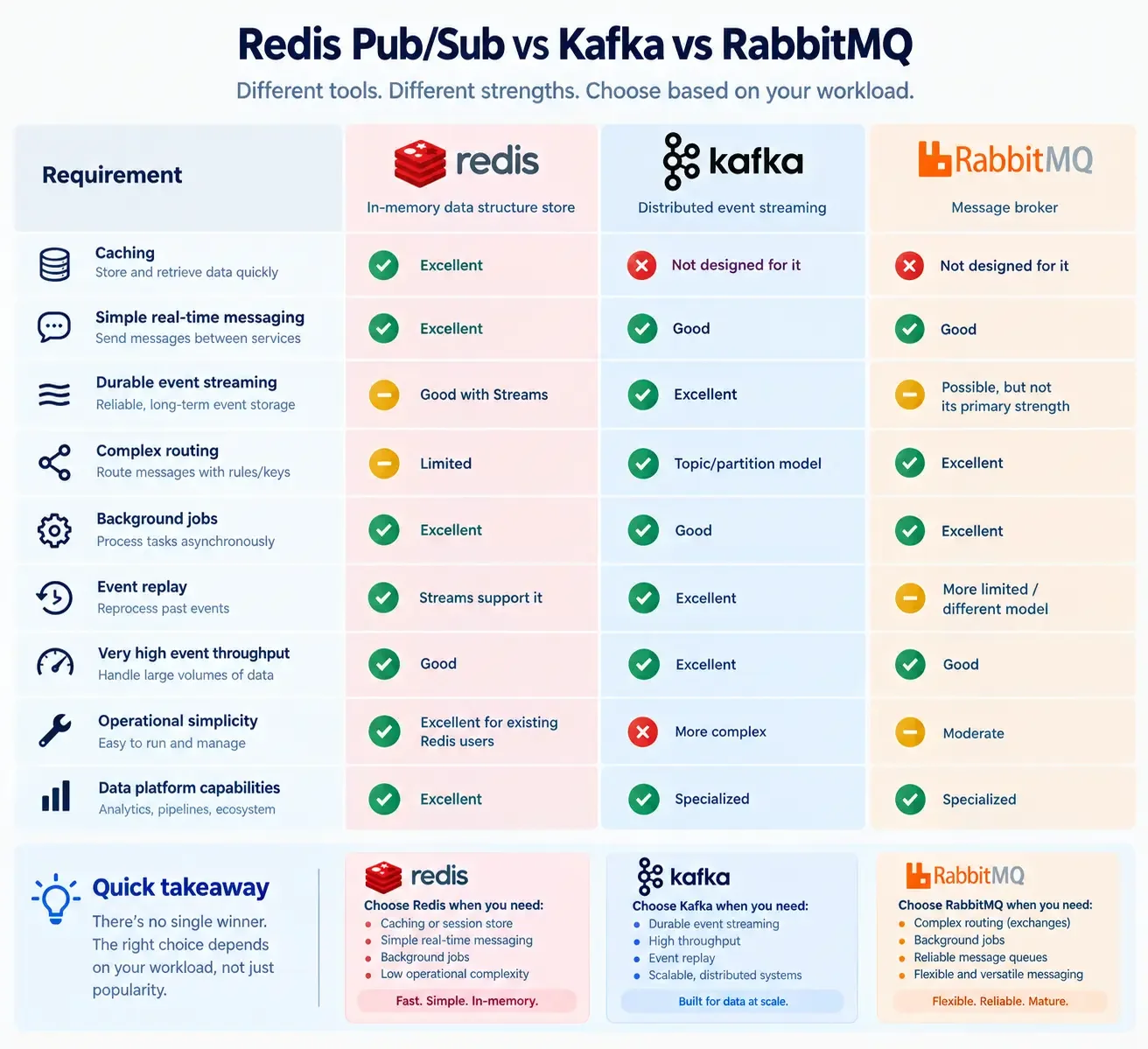
Redis Pub/Sub vs Kafka vs RabbitMQ
A useful high-level distinction is:
| Requirement | Redis | Kafka | RabbitMQ |
| Caching | Excellent | Not designed for it | Not designed for it |
| Simple real-time messaging | Excellent | Good | Good |
| Durable event streaming | Good with Streams | Excellent | Possible, but not its primary strength |
| Complex routing | Limited | Topic/partition model | Excellent |
| Background jobs | Excellent | Good | Excellent |
| Event replay | Streams support it | Excellent | More limited/different model |
| Very high event throughput | Good | Excellent | Good |
| Operational simplicity | Excellent for existing Redis users | More complex | Moderate |
| Data platform capabilities | Excellent | Specialized | Specialized |
The correct choice depends on the workload rather than the popularity of the technology.
Redis Streams vs Kafka Performance: What Should Developers Actually Measure?
Performance comparisons can become misleading because benchmark results depend heavily on workload and configuration.
When comparing Redis Streams vs Kafka performance, developers should look beyond raw messages-per-second numbers.
Consider at least these factors:
1. Throughput
How many events need to be processed per second?
A small SaaS product processing a few hundred or a few thousand events per second may not need Kafka's distributed architecture.
A large platform processing millions of events may have very different requirements.
2. Latency
How quickly does a message need to reach its consumer?
Redis is well known for low-latency operations because it primarily works with in-memory data.
Kafka can also provide very low latency, but its architecture is optimized around durable distributed streaming and high throughput rather than simply being an in-memory key-value store.
3. Message Retention
Ask how long events need to remain available.
If events only need to exist until a worker processes them, a queue may be enough.
If events need to be retained for days, weeks, or months and potentially replayed, Kafka becomes considerably more attractive.
4. Number of Consumers
Do five services need the same event?
Or does one worker need to process each task?
This distinction can influence the architecture more than raw performance.
Kafka's consumer-group model is particularly useful when multiple independent applications consume the same event stream.
5. Data Volume
The size and rate of events matter.
A system processing modest volumes may benefit from Redis's simplicity.
At large scale, Kafka's partitioning and distributed architecture can provide the infrastructure needed to scale event processing across machines.
6. Operational Complexity
This is frequently overlooked.
A technology is not truly "faster" for your business if it takes your engineering team weeks to operate correctly.
For a startup with a small engineering team, Redis can sometimes be the pragmatic choice simply because the team already understands and operates it.
As the system grows, Kafka may become worthwhile because the architectural benefits begin to outweigh its additional complexity.
How Should a Startup Decide Between Kafka, Redis, and RabbitMQ?
For startups, architecture should solve today's problems without unnecessarily creating tomorrow's operational burden.
A common mistake is adopting Kafka simply because the company expects to become large.
Designing for scale is good. Deploying infrastructure that you do not currently need can be expensive.
Start with the actual requirements.
Choose Redis when:
- You already use Redis extensively.
- You need extremely fast data access.
- Your primary requirement is caching or temporary state.
- You need simple queues or real-time messaging.
- Your event retention requirements are modest.
- Your engineering team wants minimal infrastructure overhead.
Choose Kafka when:
- Events are a central part of your architecture.
- Multiple independent services consume the same events.
- You need long-term event retention.
- Event replay is important.
- You have substantial event volume.
- You are building data pipelines or streaming analytics.
- Your architecture is becoming heavily event-driven.
Choose RabbitMQ when:
- Messages represent tasks.
- Reliable delivery is important.
- You need sophisticated routing.
- Worker-based architectures are central to your system.
- You want traditional message-broker semantics.
There is also nothing inherently wrong with using more than one technology.
For example, a mature application could use:
Redis
├── Cache
├── Sessions
└── Rate Limiting
Kafka
├── Business Events
├── Analytics
└── Data Pipelines
RabbitMQ
├── Background Jobs
└── Task Routing
The challenge is knowing whether that complexity is justified.
For startup CEOs and technical leaders, the best architecture is not necessarily the one with the most technologies. It is the architecture that gives the business the required reliability, scalability, development speed, and operating cost.
Consider the Rest of Your Technology Stack
Messaging infrastructure should also fit your application framework and development team.
For example, teams building Node.js backends may evaluate NestJS vs Express when deciding how to structure their APIs and services. The framework choice can influence how easily your team implements modules, dependency injection, background processing, and integrations with Kafka, Redis, or RabbitMQ.
Similarly, teams evaluating Fastify vs Express may prioritize API performance, ecosystem compatibility, developer experience, and the expected workload.
Infrastructure decisions should therefore be considered as part of the complete architecture rather than as isolated technology choices.
Don't Ignore the People Building the System
Even the right architecture can fail if the development team does not have enough experience to implement and operate it properly.
If your startup needs to build a React frontend alongside Node.js services, databases, APIs, queues, and event-driven infrastructure, knowing how to hire React developers with the appropriate level of full-stack understanding can make a major difference.
A remote full stack developer can also be valuable when your team needs someone who understands the entire request lifecycle—from React and API design to databases, caching, queues, and event processing.
The objective is not simply to hire someone who knows Kafka or Redis. You need engineers who understand why a particular technology should be used and what trade-offs it introduces.
A Practical Decision Framework
Before choosing Kafka, Redis, or RabbitMQ, answer these questions:
- How many messages do we currently process?
- How many messages do we expect to process in one to three years?
- Can we tolerate losing a message?
- Do messages need to be replayed?
- How long should messages be retained?
- How many independent services need each event?
- Do we need complex routing?
- Is this an event stream or a task queue?
- What latency does the application require?
- How much infrastructure can our team realistically operate?
These questions will usually produce a better architectural decision than simply comparing benchmark charts.
For many early-stage applications, Redis is enough.
For event-heavy systems with significant scale and replay requirements, Kafka can be the better long-term foundation.
For task-oriented systems with sophisticated routing and delivery requirements, RabbitMQ may be the better fit.
The key is to choose based on the problem.
Frequently Asked Questions
Everything you need to know about our development services.
There is no universal winner. Redis can provide extremely low latency for in-memory operations, while Kafka is optimized for high-throughput distributed event streaming. The appropriate comparison depends on message size, workload, persistence, consumer count, network configuration, and architecture.
2. Can Redis replace Kafka?
Sometimes, but not always. Redis Streams can handle many event-processing use cases, especially at smaller or moderate scales. Kafka is generally a better choice when long-term event retention, replayability, large-scale distributed processing, and multiple independent consumer groups are core requirements.
It depends on the communication pattern. Kafka is particularly useful when microservices consume durable business events independently. RabbitMQ is often better suited to task queues, reliable message delivery, and complex routing. Some architectures use both.
Traditional Redis Pub/Sub is designed for real-time message delivery rather than durable event storage. A subscriber that is offline generally cannot retrieve messages published while it was disconnected. If persistence and consumer recovery are important, consider Redis Streams or another durable messaging system.
No. Kafka can be an excellent technology, but it also introduces operational and architectural complexity. If your application has relatively simple messaging requirements, Redis or RabbitMQ may be easier and more cost-effective. Adopt Kafka when its capabilities solve a real business or engineering problem rather than simply because the application may scale in the future.